



IMO 2030 and Beyond: Building Future-Proof Vessels at a Chinese Private Shipyard
-
 2026-10-08
 -
 3
3
Meta description: IMO 2030, EEXI and CII rules are reshaping newbuild specifications. Here is how a future-proof vessel is designed in 2026 at a Chinese private shipyard.
Why "IMO 2030 compliant newbuild" is the most-searched phrase in shipowner procurement in 2026
The next decade of shipowning will be defined by a regulatory tightening that is already underway. The IMO's 2023 GHG Strategy committed the maritime sector to net-zero greenhouse gas emissions by or around 2050, with an interim target of a 30 percent reduction in average carbon intensity by 2030 compared with 2008. The European Union's FuelEU Maritime regulation entered force in 2025. Charterers and financiers are layering ESG-linked clauses on top of statutory rules. And the practical consequence is that the specification written into a newbuild order in 2026 has to keep a vessel competitive, financed and chartered for the next 20–25 years.
This article is a practical guide for owners, charterers and technical directors who are evaluating a future-proof vessel newbuild in 2026 and trying to understand what IMO 2030 compliant design actually means at a Chinese private shipyard.
1. What "IMO 2030 compliant" actually requires
The phrase is used loosely in marketing material. The hard rule framework behind it has three layers.
EEXI (Energy Efficiency Existing Ship Index). EEXI applies to existing vessels from their first class survey on or after 1 January 2023, and it is built into the newbuild specification from day one. A 2026 newbuild is designed so that its attained EEXI is below the required EEXI. In practice that means Tier II or Tier III main engines, a shaft generator, and a hull form optimised for the operating profile.
CII (Carbon Intensity Indicator) ratings. CII runs from A to E. From 2024, vessels rated D for three consecutive years, or E in any single year, must submit a corrective action plan. From 2027, E-rated vessels must achieve a C rating or use an approved alternative compliance mechanism. From 2030, vessels that have rated D for three consecutive years will need to comply with progressively stricter requirements. A 2026 newbuild is specified to land in CII band A or B for the first decade of its life, with enough margin to absorb regulatory tightening.
FuelEU Maritime and EU ETS. FuelEU Maritime applies to all vessels calling at EU ports regardless of flag, with progressively tightening greenhouse gas intensity limits through 2050. The EU ETS (Emissions Trading System) has applied to maritime since 2024. Both rules push the newbuild specification toward lower-carbon fuels, hybrid propulsion and shore-power compatibility.
The combined effect is that a 2026 newbuild is no longer specified for the trading pattern it will follow in year one. It is specified for the trading pattern it will follow in 2030, 2035 and 2040.
2. What "future-proof vessel design" means in practice
A future-proof vessel design in 2026 is a specification that keeps options open. The four practical decisions that drive most of the long-term value are these.
Fuel flexibility. A newbuild specified with a dual-fuel main engine capable of running on conventional fuel, LNG, methanol or (in some segments) ammonia, retains the option to switch as fuel availability and pricing change. The cost premium over a single-fuel engine is meaningful but declining, and the residual-value benefit at the next sale or charter is significant. A methanol-ready engine room that can be converted to methanol operation with a future kit upgrade is the middle option.
Hull form optimisation. A hull designed for the actual operating profile — not the brochure profile — saves fuel across the vessel's life. Computational fluid dynamics (CFD) modelling in the early design phase, supported by tank-testing at a capable facility, typically delivers a 5–12 percent reduction in resistance at service speed. That margin compounds across 20+ years of operation.
Energy recovery and shore power. A newbuild in 2026 is specified with shaft generators, waste-heat recovery systems, and shore-power compatibility as standard rather than as upgrades. A hybrid-ready electrical architecture — battery banks sized for peak shaving, hotel loads and zero-emission port manoeuvring — is increasingly the default on ferries, offshore support vessels and short-sea tonnage.
Class and flag readiness for future rules. A vessel classed by a forward-looking society (RINA, Lloyd's Register, Bureau Veritas, DNV, ClassNK) and flagged in a jurisdiction with a track record of clean implementation is in a stronger position when rules tighten further. The yard's relationship with the classification society matters as much here as the technical specification.
3. Why a Chinese private shipyard is well placed to deliver IMO 2030 compliant newbuilds
The largest yards in China and Korea have dominated the headline newbuild orders for LNG carriers and ultra-large container vessels. For the much larger mid-size newbuild order book that will be placed through 2030 — bulk carriers, product tankers, feeder container ships, RoPax ferries, offshore support vessels, fishing vessels — a private Chinese shipyard with the right engineering depth is often the most competitive answer.
Three capabilities make a Chinese private shipyard competitive on future-proof design.
In-house structural and outfitting engineering. A yard that controls hull form development, structural analysis and outfitting design under one roof can absorb a late change to the machinery envelope without waiting on an external design house. That matters when a methanol-ready or ammonia-ready engine room is being fitted into a hull designed for a Tier II conventional installation.
Classification relationships. A serious Chinese private shipyard holds standing relationships with RINA, Lloyd's Register, Bureau Veritas, DNV and ClassNK, and has delivered newbuilds to each. The class interface is a discipline in its own right, and the yards that have invested in it work through EEXI, CII and FuelEU documentation more cleanly.
Workforce stability and welfare. A yard with low welder and fitter turnover produces cleaner welds, fewer rework cycles and tighter dimensional control. That sounds like a quality argument, but it is also a future-proof argument: a vessel built by a stable workforce ages more predictably, and that predictability is what keeps CII ratings in band A or B over the first decade.
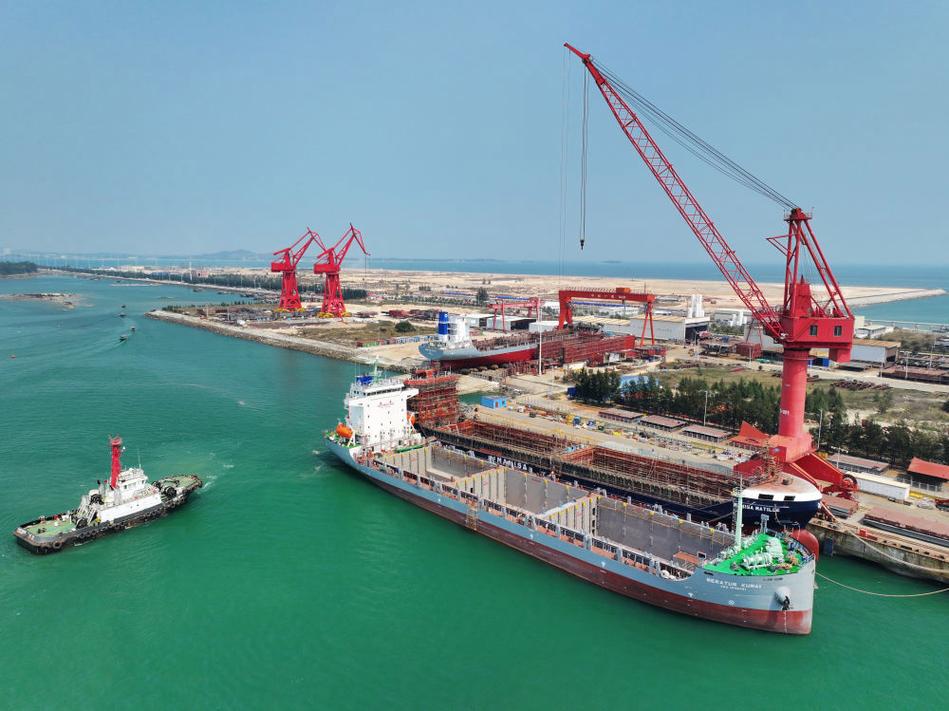
Taizhou Changlong Shipbuilding Industry Co., Ltd. — a private yard in Wenling, Zhejiang — has built a diversified order book across bulk carriers, fishing vessels, container ships, RoPax ferries and engineering vessels, with classification relationships across the major societies. The yard is open for technical visits by owners and charterers evaluating an IMO 2030 compliant newbuild in 2026.
4. The 2026 specification envelope for a mid-size future-proof vessel
For a handysize or supramax bulk carrier newbuild specified for IMO 2030 compliance, the typical 2026 specification envelope looks like this.
Main engine: Tier III-ready, dual-fuel methanol-conventional capable, with methanol-ready engine room conversion pathway.
Auxiliaries: Shaft generator, two auxiliary generators with selective catalytic reduction capability, hybrid-ready switchboard.
Hull form: CFD-optimised for service speed of 13.5–14.5 knots with a 5–10 percent resistance reduction versus a conventional hull.
Coatings: Low-friction antifouling, corrosion protection rated for 7.5-year interval.
Class and flag: RINA, Lloyd's Register, Bureau Veritas, DNV or ClassNK; flag selected for clean implementation of EEXI and CII.
Shore power: Cold ironing-ready with standardised connection.
Data and digital twin: Onboard data infrastructure compatible with class digital twin systems and charterer ESG reporting.
For a RoPax ferry specified for tropical coastal service, the equivalent 2026 envelope is hybrid LNG-electric propulsion with battery storage sized for zero-emission port manoeuvring, a hull form optimised for 18-knot cruising in sea states 3–4, and accommodation standards consistent with extended-service crew welfare.
For a fishing vessel specified for distant-water operations, the envelope is a Tier III main engine, shaft generator, RSW refrigeration upgrade pathway, fuel-flex capability where available, and accommodation designed for compliance with ILO Work in Fishing Convention (C188).
The right envelope depends on the segment, the trading pattern, and the operator's financing and chartering strategy. A yard that asks the right questions in the first meeting is in a better position to deliver a vessel that holds its value through the regulatory tightening of the late 2020s and the 2030s.
5. How to evaluate an IMO 2030 compliant newbuild yard
The phrase "IMO 2030 compliant" appears on most yard marketing material in 2026. The serious evaluation works through five questions.
What fuel-flex options are written into the newbuild specification? A real fuel-flex specification names the fuels, the conversion pathway and the classification approval pathway.
What is the CII projection for years 1, 5, 10 and 15? A yard with the right modelling tools can show the projected CII trajectory. A yard that cannot has not done the work.
What is the energy-recovery and shore-power package? Shaft generator, waste-heat recovery, battery hybrid capability and shore-power connection should be specified at signing, not as an upgrade.
What classification society and flag? A forward-looking class relationship and a clean-implementation flag is a 20-year decision.
What after-sales and retrofit support? A future-proof vessel will be retrofitted multiple times during its service life. The yard that supports those retrofits is part of the value.
A serious answer to those questions is the difference between a newbuild that holds its value and a newbuild that becomes a stranded asset.
6. The 2026 takeaway
IMO 2030 compliance is no longer a marketing line. It is a specification discipline that affects contract price, financing cost, charter eligibility and residual value. For mid-size newbuild orders — bulk carriers, product tankers, feeder container ships, RoPax ferries, offshore support vessels, fishing vessels — a well-run Chinese private shipyard is the most competitive answer on technical depth, on flexibility and on total landed cost.
Taizhou Changlong Shipbuilding Industry Co., Ltd. delivers future-proof vessel designs across bulk carriers, fishing vessels, container ships, RoPax ferries and engineering vessels, with classification relationships across RINA, Lloyd's Register, Bureau Veritas, DNV and ClassNK. For owners evaluating an IMO 2030 compliant newbuild in 2026, the yard is open for technical visits and commercial discussions.
Quick reference: future-proof newbuild specification checklist
Specification item | What to look for in 2026 |
Main engine | Tier III, dual-fuel or methanol-ready with documented conversion pathway |
Auxiliaries | Shaft generator, SCR-capable auxiliary generators, hybrid-ready switchboard |
Hull form | CFD-optimised, tank-tested, 5–12 percent resistance reduction |
Coatings | Low-friction antifouling, 7.5-year coating interval |
Energy recovery | Waste-heat recovery, hybrid battery capability, shore-power connection |
Classification | RINA, Lloyd's Register, Bureau Veritas, DNV or ClassNK with EEXI/CII/FuelEU experience |
Digital infrastructure | Onboard data compatible with class digital twin and charterer ESG reporting |
Accommodation | C188-compliant for fishing vessels, future-ready for crew retention |
Build for the next decade, not just the next quarter
A newbuild ordered in 2026 will still be trading in 2045. The specification choices made at signing decide whether it is a competitive asset or a stranded one through that period. Taizhou Changlong Shipbuilding Industry Co., Ltd. is open for technical visits and commercial discussions for future-proof newbuild projects in 2026 and beyond.
Contact Information
Company: Taizhou Changlong Shipbuilding Industry Co., Ltd.
Address: Tianxi Center, Songmen Town, Wenling City, Taizhou, Zhejiang Province, China
中文地址: 浙江省台州市温岭市松门镇天玺中心
E-mail: taosan171@gmail.com
Phone: +86 13736657777 / +86 13676683567


关注微信公众号
